Munich 3-day itinerary
- 3 days
- Balanced pace
- About 35 min walking a day
3 days in Munich, planned the tabi way — one neighbourhood per day, gapless timing, every stop chosen from 44 human-verified places across 8 curated neighbourhoods. Open it offline and follow it street by street, or make it the starting point for your own plan.
Day by day
Day 1Altstadt & Marienplatz & nearby — a sights dayMunich, 9 stops
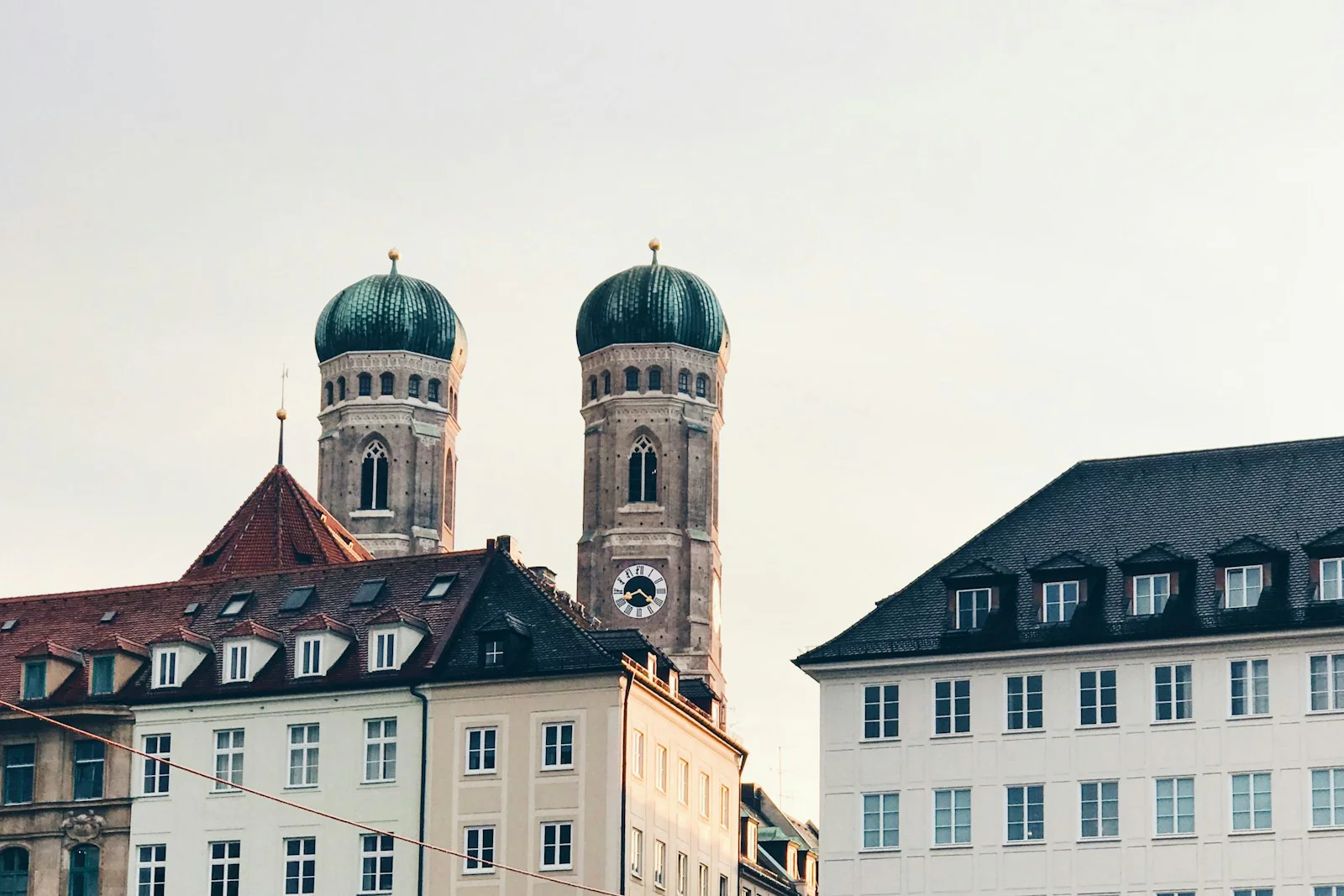
Munich's pedestrian core radiates out from Marienplatz, where the Rathaus-Glockenspiel draws a crowd at 11 and noon and the twin onion domes of the Frauenkirche anchor every skyline photo. Duck into the Viktualienmarkt for a Weißwurst breakfast among stallholders who've worked the same corner for decades, wander the Residenz's state rooms for a dose of Wittelsbach excess, then let the evening land at a long communal table in the Hofbräuhaus — touristy, loud, and still somehow the room everyone ends up in at least once. Shopping runs Kaufingerstraße and Neuhauser Straße, but step one street back from the marquee route and prices — and crowds — drop fast.
- 08:30
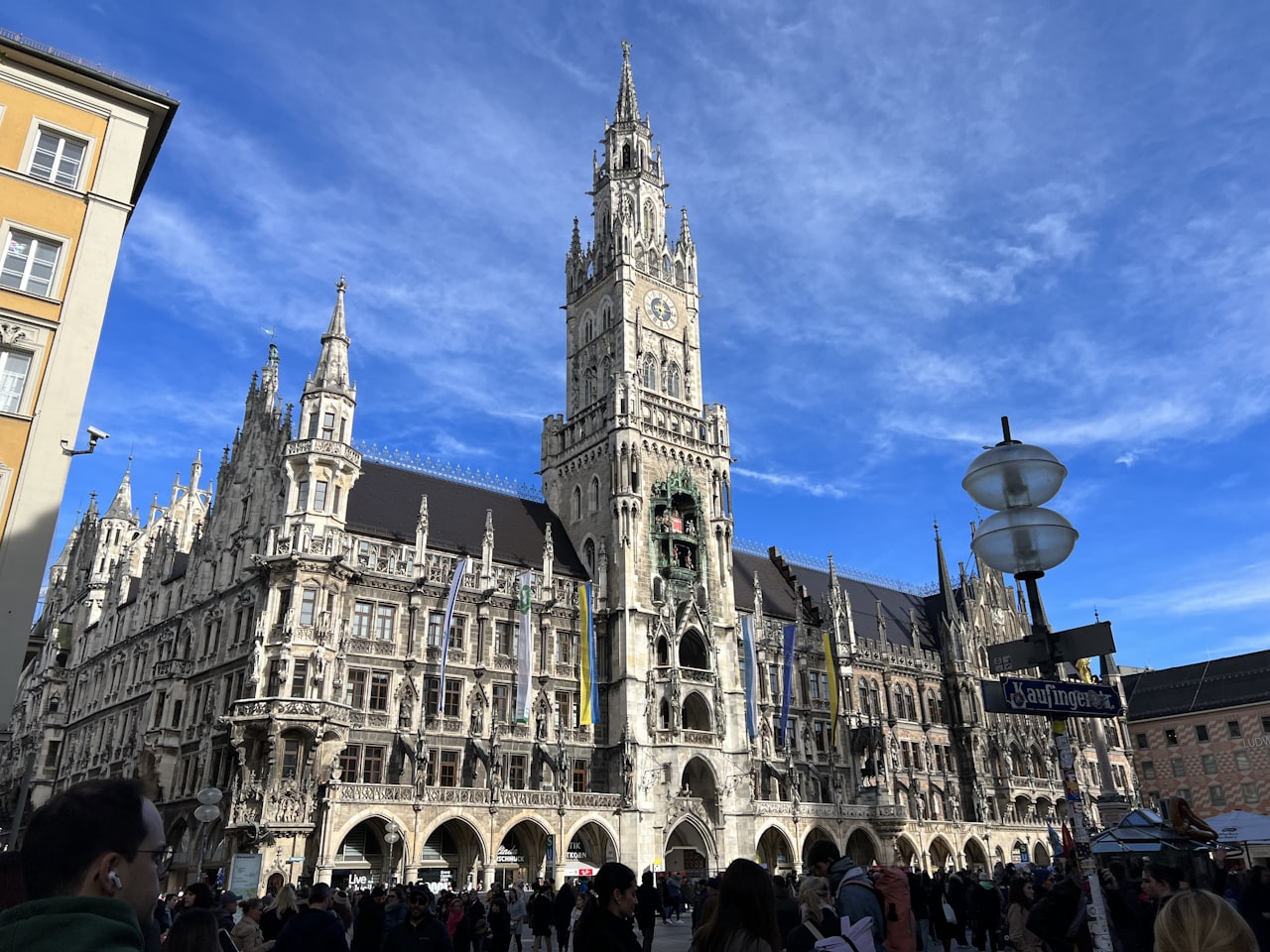
The Rathaus-Glockenspiel on the New Town Hall's tower chimes at 11:00 and 12:00 daily, plus 17:00 from March to October — each performance runs about 12 minutes and re-enacts a 16th-century royal wedding joust above a coopers' dance said to have coaxed Munich back onto the streets after the plague. A shorter, quieter sequence plays at 21:00: a night watchman and the Münchner Kindl appear in the side windows, no crowd required. The square itself is fully pedestrianised and never closes.
- 09:05Viktualienmarkt
Munich's produce market has run on this square since the early 1800s. Individual stalls generally trade Monday-Saturday, roughly 08:00-20:00, and close on Sundays — a handful of flower, bakery and caterer stands are the legal exception and may still open under Bavaria's Sunday-trading rules. The square itself is open, flat and freely walkable at any hour.
- 10:05Dallmayr
Munich's grand delicatessen since the 1700s — a flagship food hall for coffee, chocolate, caviar and prepared delicacies just off Marienplatz. Open Monday-Thursday and Saturday 09:30-19:00, Friday 09:30-19:30, closed Sundays and Bavarian public holidays under the state's strict Sunday-trading law. Cards are accepted and the building is wheelchair accessible.
- 10:50Frauenkirche
The twin-domed cathedral's nave is free to enter daily 08:00-20:00. Climbing the south tower is a separate, ticketed trip (around €7.50, Mon-Sat 10:00-17:00, Sun/holidays from 11:30, last ascent 16:30) up a narrow spiral staircase with no lift, so it isn't wheelchair-accessible even though the church itself carries an official barrier-free certification. There's no accessible toilet on site.
- 12:00Lunch Deutsche Eiche
A Munich institution since the 19th century (the building's neoclassical facade dates to 1864) and one of the city's oldest meeting points for the LGBTQ+ community — part hotel, part traditional Bavarian restaurant, part sauna, with a rooftop terrace overlooking the old town's spires. The kitchen serves hearty, unpretentious Bavarian food (Käsespätzle, Obazda, a Wiener-schnitzel riff, the self-mockingly named currywurst 'Der längste Lümmel der Eiche') alongside a genuinely labelled vegan salad ('Frisch & Fruchtig Veganista' — fried seasonal mushrooms, pomegranate, walnuts) — so it isn't only meat-and-beer despite the traditional menu. Kitchen serves hot food from 11:30 to 23:00 daily; breakfast runs 7:00–11:30. The rooftop terrace only opens in warmer months and stays open later (to midnight) on Fridays, Saturdays and the evening before a public holiday.
- 13:00Munich Residence
The Wittelsbachs' city palace is open daily, 09:00-18:00 from late March to mid-October and 10:00-17:00 the rest of the year, closed on 1 January, Shrove Tuesday and 24/25/31 December. A standard adult ticket to the Residenzmuseum's state rooms is around €10, with combination tickets covering the Treasury and the Cuvilliés Theatre; under-18s enter free. It's a large complex — the Antiquarium and the Ancestral Gallery alone are worth budgeting real time for.
- 14:45
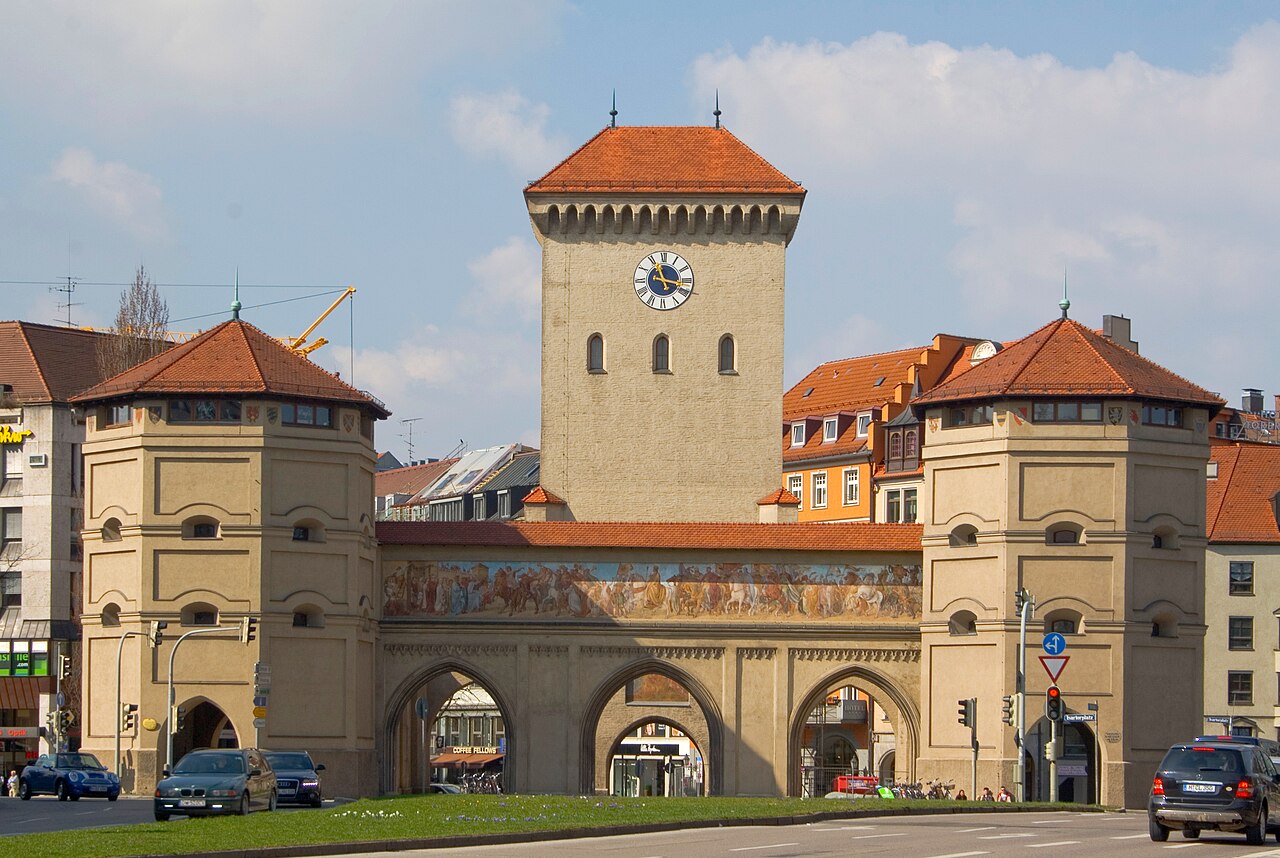
The only one of Munich's three surviving medieval city gates still standing close to its original 1337 form, at the eastern edge of the old town where the pedestrian street Tal begins. A 19th-century restoration added the neo-Gothic side towers and, on the tower's east face, Bernhard Neher's large fresco of Ludwig the Bavarian's 1322 victory parade — worth a look up before crossing under the arch. A quirk locals point out to visitors: the clock installed on the west face in 2005 runs counter-clockwise, a nod to Munich comedian Karl Valentin. Those side towers now house the small Valentin-Karlstadt-Musäum, a separate ticketed museum dedicated to Valentin and fellow performer Liesl Karlstadt — visiting the gate itself, underneath and around it, costs nothing and needs no ticket. It marks the seam between the old town and the Glockenbachviertel/Isarvorstadt: turn south from here and you're immediately in the museum-and-nightlife district.
- 15:15Flaucher (Isar Riverbank)
The stretch of the Isar just south of the old town where the river splits around gravel islands, and where Munich actually goes to relax rather than sightsee — locals wade in the shallow channels, grill on the gravel banks (open fires are banned, but contained grills are fine and the police do check), and picnic under the willows within earshot of the historic 'Zum Flaucher' beer garden, which seats around 2,000 and runs year-round rather than just in summer. Free drinking-water fountains are dotted along the banks. It's also one of the city's designated nude-bathing (FKK) stretches, so don't be surprised by bathers with no swimsuit alongside families in full kit — both are normal here. No entry fee, no gates, and no fixed hours; the Flauchersteg footbridge is the easiest way across if you want both riverbanks. Hellabrunn Zoo sits immediately south if you want to extend the afternoon.
- 17:30Dinner Nürnberger Bratwurst Glöckl am Dom
A real Bavarian grill house, not a tourist-menu copy — Rostbratwürstl grilled over an open beechwood fire, right behind the Frauenkirche. Open daily 10:00 to 01:00 (Sundays and holidays until 23:00). The card explicitly lists cheese-based options like Obatzda and a mixed salad alongside the sausage platters, so it isn't meat-only. EC, Visa and Mastercard are all accepted, but there's no lift and no wheelchair-accessible toilet, so wheelchair access is limited.


Day 2Englischer Garten & Schwabing & nearby — a sights dayMunich, 11 stops
One of the largest urban parks in the world starts a few minutes' walk from the museum quarter and just keeps going — past the Chinesischer Turm's biergarten, where a full litre of Augustiner arrives whether you asked for it or not, up along the Eisbach, where a permanent standing wave draws a rotating cast of river surfers year-round, cold weather included. Push north and the park lets out into Schwabing, a onetime bohemian quarter now given over to Leopoldstraße's bars and Münchener Freiheit's café tables — a natural place to land once the park closes out the afternoon.
- 08:00Breakfast Café Puck
A relaxed neighbourhood café on Türkenstraße, open daily 09:00 to 01:00. The kitchen confirms vegetarian options, and cards are accepted, but the café is not wheelchair accessible.
- 08:30Monopteros
Leo von Klenze's small domed temple (1832-36) sits on an artificial hill a short climb from the main paths, its ring of Ionic columns framing one of the park's best free views — the Frauenkirche's domes and the Residenz are both visible on a clear day. Popular at sunset; there's no shade and no facilities, so treat it as a stop rather than a destination.
- 09:05
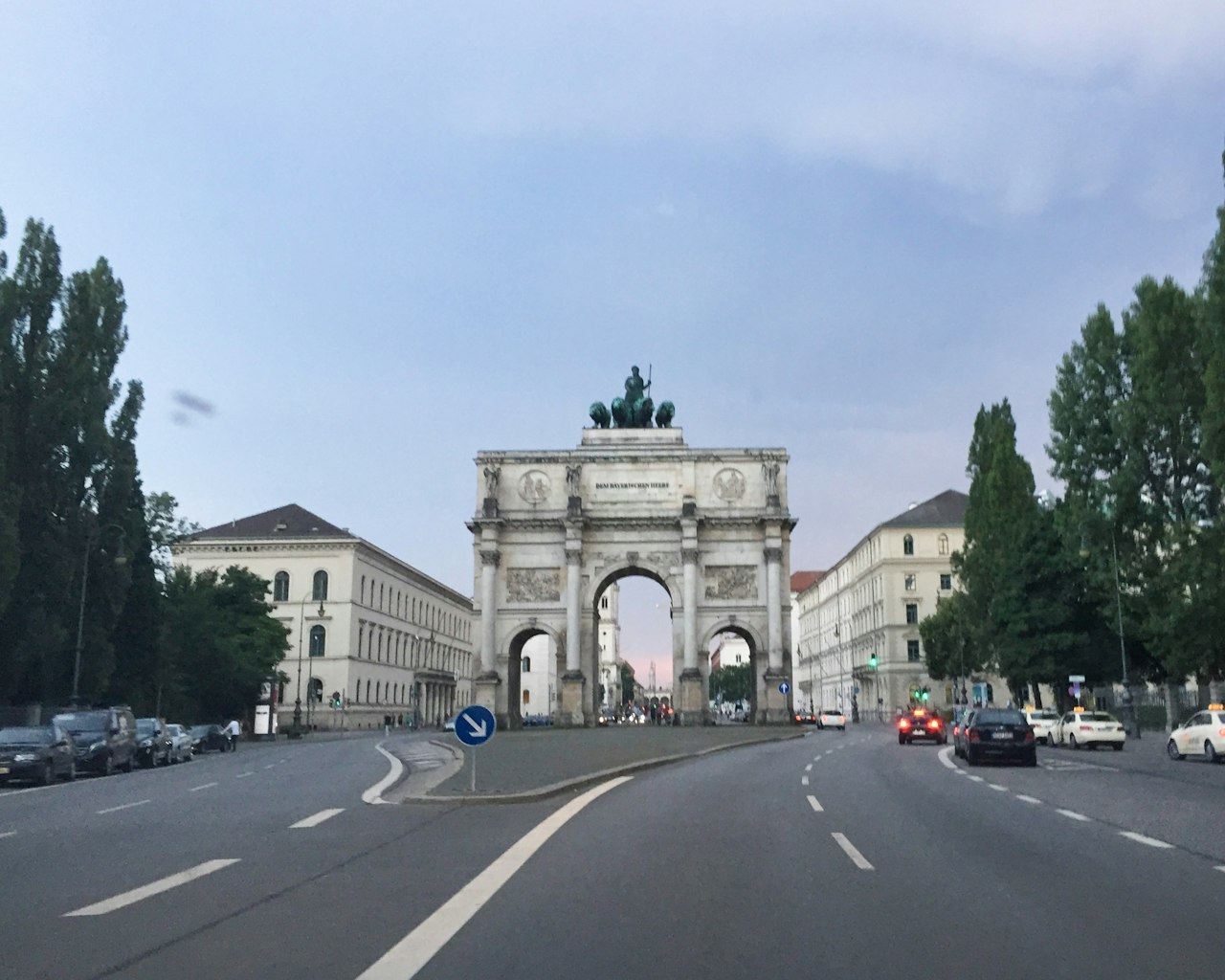
King Ludwig I's 1852 triumphal arch, badly damaged in WWII and deliberately left only partially restored: the rear inscription reads 'Dedicated to victory, destroyed by war, urging peace.' It's a free, view-only landmark marking the boundary between Maxvorstadt and Schwabing, where Ludwigstraße becomes Leopoldstraße.
- 09:35Geschwister-Scholl-Platz (LMU)
Hans and Sophie Scholl were arrested here on 18 February 1943 for distributing White Rose resistance leaflets inside the university's main hall, and executed four days later. A memorial fountain in front of the building marks the spot; the square and the university's façade are always viewable and free. Note for wheelchair users: the paths to the building's accessible entrances are cobblestone, and the accessible toilet needs a special key held by the university.
- 10:10Pinakothek der Moderne
Design, graphics, architecture and modern-contemporary art under one roof, closed Mondays. Thursdays it's open until 20:00, other days 10:00-18:00, with €1 admission every Sunday. Barrier-free access is available from both the Barer Straße and Gabelsbergerstraße entrances, with lifts to every department and wheelchairs available on reservation.
- 12:00Lunch Alter Simpl
A literary Kneipe on Türkenstraße since 1903, named after the satirical magazine Simplicissimus and once a haunt of Schwabing's bohemian crowd. Open Monday-Wednesday until midnight, Thursday-Saturday until 01:00, Sunday and holidays until 23:00. They take credit or EC debit cards.
- 13:00Alte Pinakothek
One of the world's great Old Masters collections — Dürer, Rubens, Rembrandt — closed Mondays. Tuesday and Wednesday it stays open until 20:00, other days 10:00-18:00. A standard ticket is €9 (€6 reduced), but every Sunday admission drops to €1. The main entrance is barrier-free with four lifts serving all galleries, wheelchairs available on request at the info desk.
- 14:45Lenbachhaus
Home to the world's largest collection of Der Blaue Reiter (Blue Rider) paintings — Kandinsky, Marc, Klee. Closed Mondays, open until 20:00 on Thursdays and 18:00 the rest of the week. The museum describes itself as fully wheelchair-accessible: level entrance, elevators to every floor, two disabled parking spaces on Luisenstraße, and wheelchairs available on loan. Note that the underground Kunstbau gallery is closed through 2026 for renovation work.
- 16:15
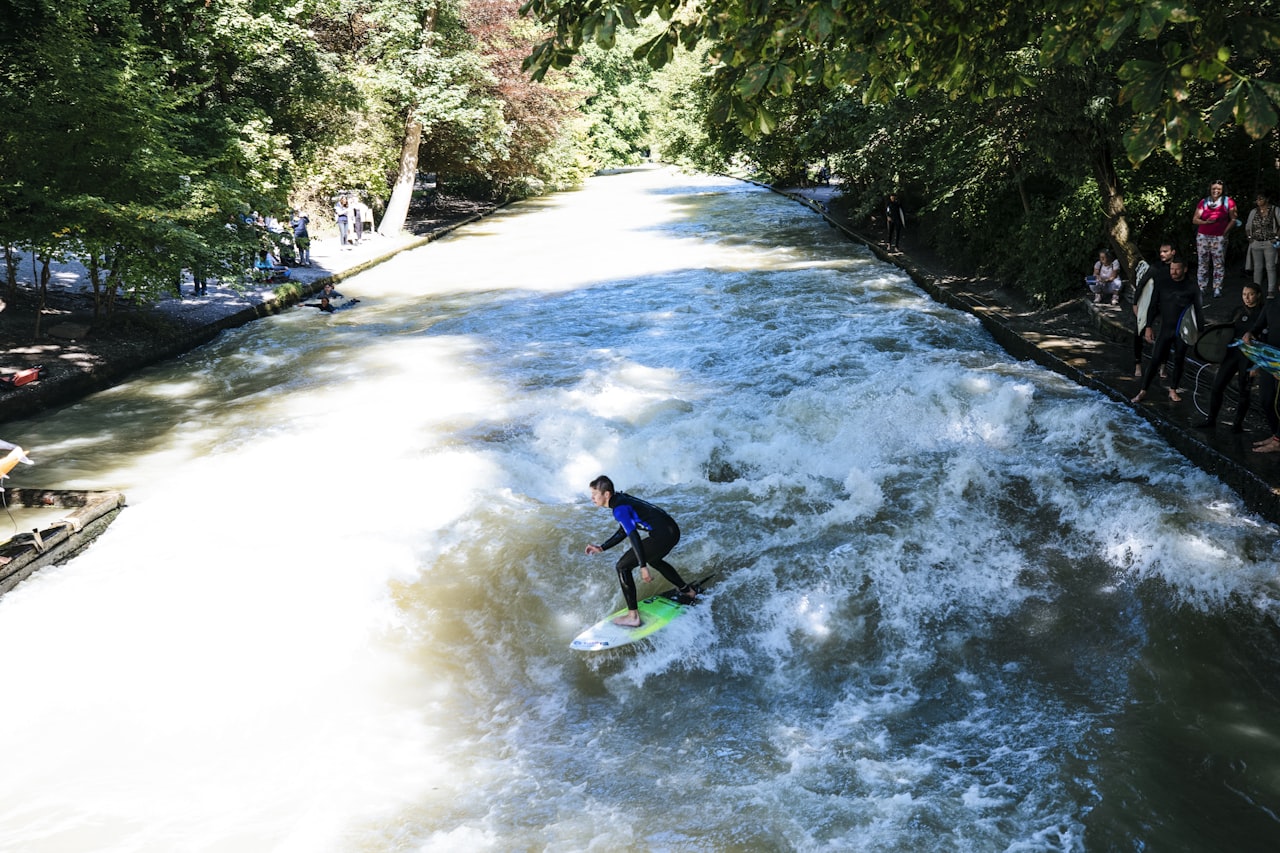
A permanent standing wave in the Eisbach river draws river surfers year-round, even through winter — watch from the Prinzregentenstraße bridge or the bank just below Haus der Kunst. This is a spot for watching, not trying: the water never warms much above 15°C, and the current, submerged rocks and downstream weirs have caused serious injuries to inexperienced surfers. Free and always accessible, and an easy add-on to a walk into the park proper.
- 16:50Kleinhesseloher See
An 8.6-hectare artificial lake dug in 1803, ringed by paths and lawns that thin out the crowds within a few minutes of the park's busier southern half. A seasonal pedal-boat and rowboat rental runs from the eastern bank in the warmer months, and the Seehaus restaurant sits right on the water if you want a sit-down break. Good for a slow lap or a picnic; no ticket needed.
- 17:45Dinner Max-Emanuel-Brauerei
A brewery and beer garden running since 1880, named after the Bavarian Prince-Elector nicknamed 'the Blue Elector,' and a genuine university-quarter fixture rather than a tourist stop. Weekday hours don't start until noon, so it's an evening or weekend plan rather than a lunch drop-in: Monday-Thursday 12:00-23:00, Friday 12:00-24:00, Saturday 10:00-24:00, Sunday and holidays 10:00-22:00. Vegetarian dishes are confirmed on the menu; the beer garden is weather-dependent and not wheelchair accessible.


Day 3Schloss Nymphenburg & its Park & nearby — a sights dayMunich, 6 stops
The Wittelsbachs' summer palace sits at the end of a long formal canal, and a day here is really two: the palace's state rooms and the Marstallmuseum's royal carriages first, then the park itself, which is big enough to lose the crowds within ten minutes of the main facade — English-style groves, four smaller pavilions (the Amalienburg's rococo hall of mirrors is worth the walk alone), and the Botanical Garden tucked against the park's northern edge. Bring a picnic; there's little reason to rush back for lunch.
- 07:40Check out of your stay
- 09:00
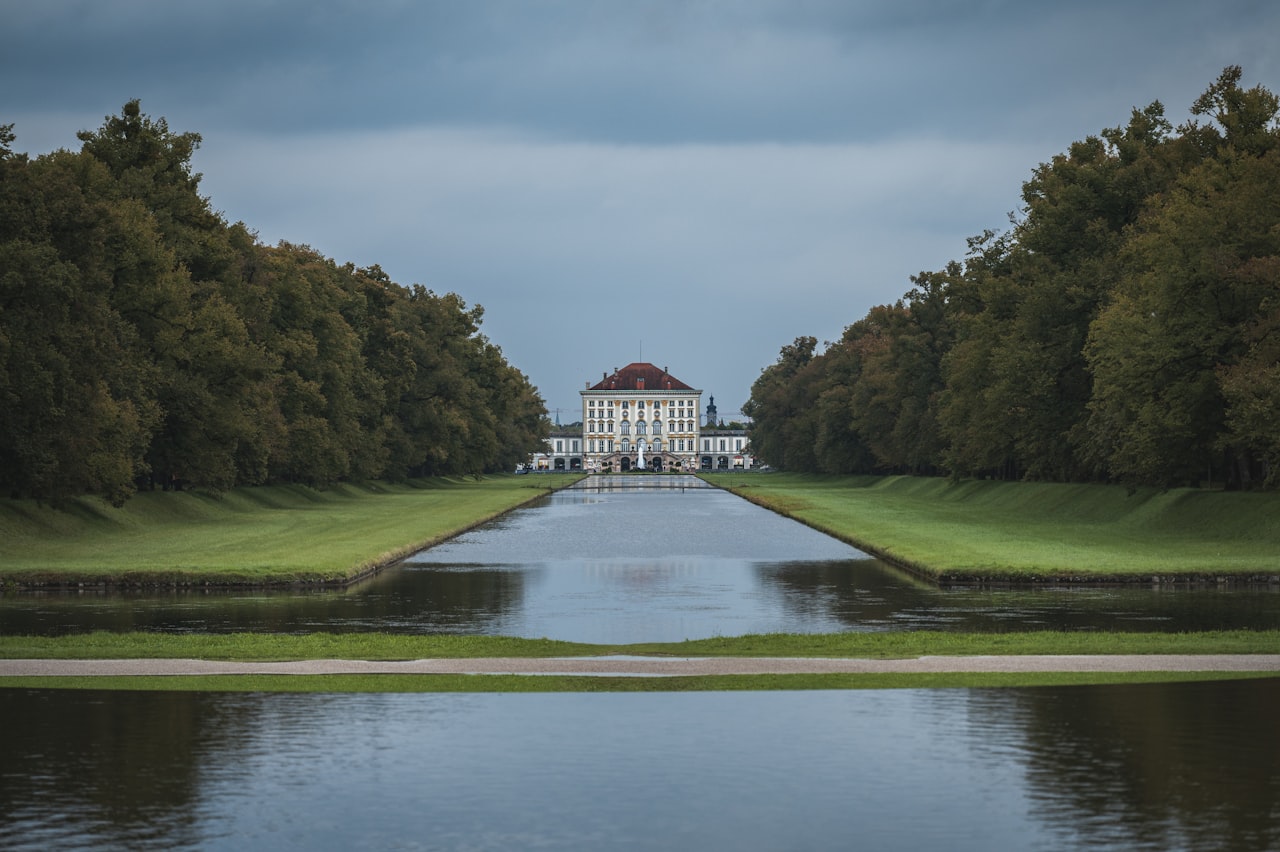
The Wittelsbachs' summer palace opens its state rooms daily 09:00-18:00 from April to mid-October, dropping to 10:00-16:00 the rest of the year — the comprehensive ticket also covers the Marstallmuseum and the park pavilions, which close entirely for winter (see the Amalienburg entry). Everything is shut on 1 January, Shrove Tuesday, and 24/25/31 December, and the Lackkabinett lacquer room is closed for restoration into around autumn 2026. There's step-free access to the left of the main entrance and a lift to the upper floor; the long formal canal out front is free to walk and open far longer hours than the museum itself.
- 11:15Marstallmuseum (Royal Stables Museum)
The Wittelsbachs' state carriages and sledges fill the palace's south wing on the ground floor, step-free from the entrance, with the Nymphenburg porcelain collection upstairs via lift — look out for the elaborately gilded coronation coach. Runs on the same hours and the same comprehensive ticket as the palace itself, dropping to 10:00-16:00 outside the April-mid-October season.
- 12:15Lunch Schlosscafé im Palmenhaus
A café inside a historic palm-house greenhouse at the edge of the palace park, serving breakfast and brunch through early afternoon with both vegan and vegetarian dishes alongside the traditional menu. Open Tuesday-Friday 11:00-18:00, Saturday 10:00-18:00 and Sunday 10:00-15:00 (Sunday breakfast until 14:00); closed Mondays.
- 13:15
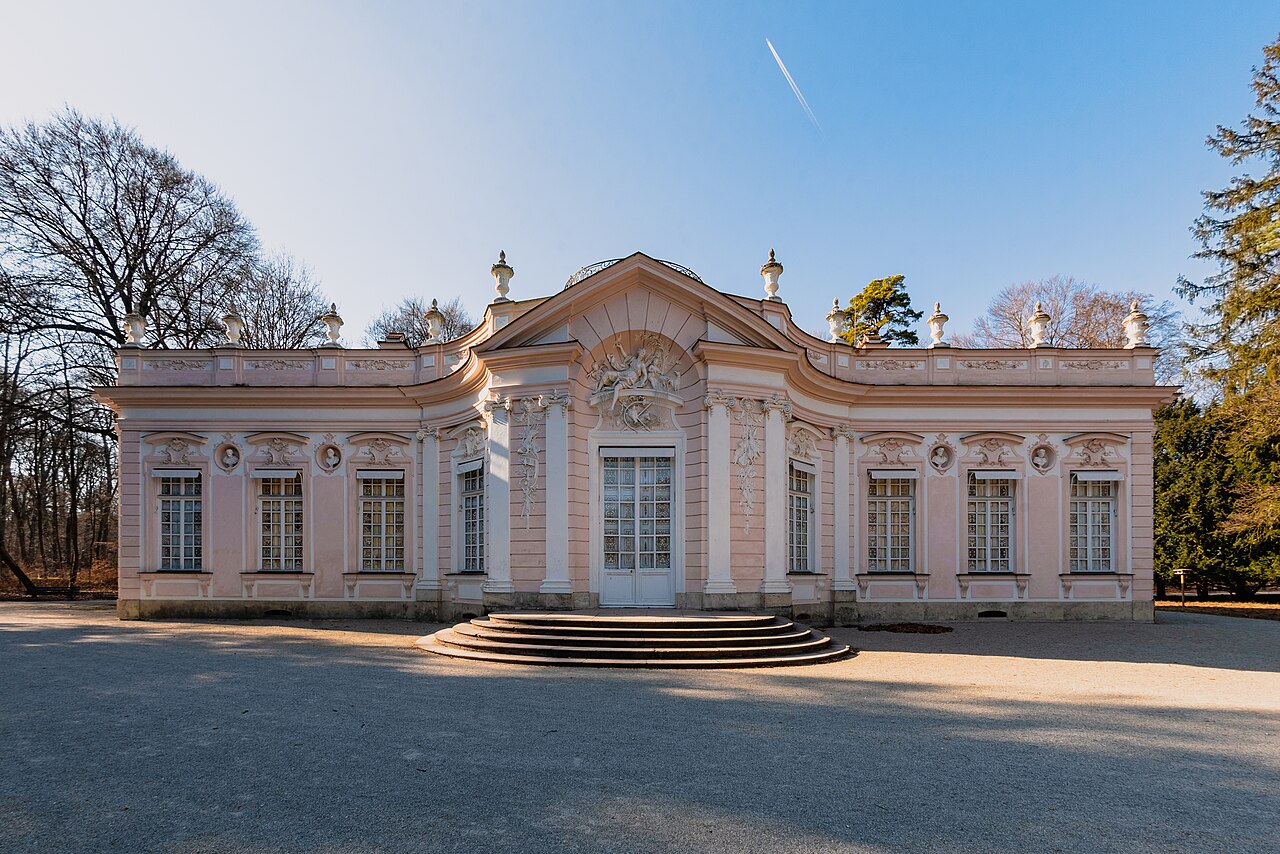
The smallest and finest of the park's four pavilions, built 1734-39 by François de Cuvilliés — its circular Spiegelsaal (Hall of Mirrors), all silver stucco and pale blue, is genuinely one of the best rococo interiors in Bavaria and worth the walk on its own. Covered by the palace's comprehensive ticket, but closed completely from mid-October to the end of March — this is a summer-only stop, so don't plan a winter Nymphenburg day around it.
- 14:00Munich Botanical Garden
Tucked against the park's northern edge, this is a real botanical garden rather than a palace add-on — greenhouses, an alpine garden and a rock garden, with paths that stay genuinely uncrowded even when the palace grounds are full. Outdoor gardens run roughly 09:00-18:00 from late March to late October and shorter winter hours the rest of the year; closed 24 and 31 December. Wheelchair users can reach the main paths, though the fern ravine's narrow stream-side trail and the alpine garden's inner loop aren't passable, and e-wheelchairs don't fit inside the greenhouses.
- 15:46Olympic Swimming Hall
The actual 1972 Olympic competition pool, still open to the public for lengths and lane swimming rather than preserved as a museum piece — this is the pool Mark Spitz swam his seven gold medals in, and you can buy a day ticket and swim it yourself. Regular pool entry is €6.90; a 4-hour sauna-plus-pool ticket is €23. The facility has disability-friendly, wheelchair-accessible fittings, including accessible changing rooms and pool-entry assistance. Open daily 7:00–23:00 (the sauna and fitness areas keep slightly different hours). Note: the whole hall closes for its annual deep-clean/maintenance for about three weeks every late summer — it was scheduled 24 August–14 September 2026 — so check swm.de before planning a visit in that window.

